MGMT 803, MBA@Rice, 2026
Thursday, September 24, Morning
J. Howard Creekmore Professor of Finance
About me
Position
J. Howard Creekmore Professor of Finance and Professor of Economics
At Rice since 2009. Before that, Northwestern, Indiana, Washington University in St. Louis, and Texas A&M
Teaching
- Gen AI and Quant Investments (MBA)
- Applied Finance (MBA)
- Agentic AI, Data, and Decisions (MBA)
- Asset Pricing (PhD)
- Data-Driven Finance (MDS)
- AI and Data Management (ENGI)
- Making Data-Driven Decisions with Agentic AI (Exec Ed)
Four days
| When | Topics | |
|---|---|---|
| 1 | Thursday morning | How LLMs work · models · computer use · how agents work · doing work with AI · prompting |
| 2 | Thursday afternoon | AGENTS.md, SKILL.md · connectors and plugins · harnesses |
| 3 | Friday morning | Working with data |
| 4 | Saturday morning | Creating docs · creating apps |
| 5 | Saturday afternoon | Retrieval augmented generation · open source models |
| 6 | Sunday morning | Creating agents · managing security risks |
Every session has hands-on blocks in your own container. Bring a laptop and stay on wifi for four days.
This morning
| Topic | What it covers | |
|---|---|---|
| 1 | How language models work | Tokens, vectors, training, and why they fail |
| 2 | Models and performance | Who makes them, what they cost, how they compare |
| 3 | Computer use | Models that click and type, in a browser or on the desktop |
| 4 | How agents work | Chatbots, tools, and what is written into the harness |
| 5 | Doing work with AI | Where to work, and what is in your lab container |
| 6 | Prompting tips | Planning, code for numbers, checking what comes back |
A brief history
| When | What |
|---|---|
| 2017 | Google researchers publish the transformer (“Attention Is All You Need”) |
| 2020 | GPT-3 (OpenAI) shows abilities that appear with scale |
| 2022–2023 | Online chatbots. You typed, it typed back |
| 2023–2024 | Code execution and web search arrive |
| 2025 | The serious versions move to the command line, reading and writing files on your own machine. DeepSeek R1 appears |
| 2025–2026 | That command-line capability is wrapped back into an app |
| 2026 | Agents that carry out extended work on your files without you living in a terminal |
Andrej Karpathy: OpenAI co-founder, former Tesla AI chief, now at Anthropic
October 2025
“They just don’t work. They don’t have enough intelligence, they’re not multimodal enough, they can’t do computer use and all this stuff. They don’t have continual learning. You can’t just tell them something and they’ll remember it.”
“I feel like the industry is making too big of a jump and is trying to pretend like this is amazing, and it’s not. It’s slop.”
December 2025
“I really am mostly programming in English now, a bit sheepishly telling the LLM what code to write… in words. Biggest change to my basic coding workflow in ~2 decades.”
February 2026
“It is hard to communicate how much programming has changed due to AI in the last 2 months: not gradually and over time in the ‘progress as usual’ way, but specifically this last December. Coding agents basically didn’t work before December.”
“I don’t think I’ve typed like a line of code probably since December.”
1 · How language models work
Enough of the mechanism to explain what these models are good at and where they fail. Every failure you meet over the four days has a cause in this block.
Tokenization
Text is cut into pieces from a fixed vocabulary before the model sees any of it.
"The cat sat on the mat"  ->  ["The", " cat", " sat", " on", " the", " mat"]

"Unbelievable"            ->  ["Un", "believ", "able"]
Common words stay whole; rare and long words break into pieces. A typical vocabulary runs to about 100,000 tokens.
Numbers break on the same rules, which have nothing to do with arithmetic. 13,963,378.65 reaches the model as a handful of unrelated pieces.
The whole task
Given the tokens so far, predict the token that comes next. That is the entire operation.
Everything a model appears to do — answering, summarizing, writing code, refusing — is that one prediction, repeated.
The input can currently run to about a million tokens, roughly two-thirds of the Harry Potter saga.
Vectors
The model does not work with tokens. It works with numbers.
Each token is a list
“king” becomes 4,096 numbers. “queen” becomes 4,096 numbers that are close to them.
Tokens used in similar contexts end up near each other.
The space is mostly empty
There are far more possible vectors than there are tokens, so most points in the space name nothing.
The prediction can land between tokens.
A neural network is a function
The idea
\(y = 4x\) is a function. The 4 is a parameter.
Change it to 3 and you have the same structure with different behavior.
The scale
Same idea with hundreds of billions of parameters, arranged as a transformer — the architecture published by Google researchers in 2017.
Training
What is learned
The vector for every token, and every parameter in the network.
Both are adjusted together to reduce prediction error on the training text.
What it takes
Trillions of words. Thousands of GPUs for weeks or months. Tens to hundreds of millions of dollars for one run.
Nothing is looked up or stored as fact. The arrangement captures how words are used, which is why it recalls common things reliably and rare things unreliably.
The pipeline
- Tokenize the input.
- Look up the vector for each token.
- Feed the vectors into the network.
- The network produces one output vector.
- Find which token vectors are closest to it.
- Emit a token, append it to the input, and start again at step 1.
Temperature
The network does not output one token. It outputs a probability for every token in the vocabulary. Temperature controls how that distribution is sampled.
| Setting | Behavior |
|---|---|
| Near 0 | The highest-probability token every time. Repeatable. |
| Near 1 | Sampled from the distribution. Different each run. |
| Higher | Low-probability tokens get picked. Text degrades. |
In a chatbot, including Claude Desktop, temperature is fixed near 1 and you cannot change it. Through the API you can.
From prediction to conversation
A model trained only to predict the next token continues your text. It does not answer a question.
- Role tokens. The text is wrapped in markers:
<|user|>your question<|assistant|>. - Instruction tuning. The model is further trained on examples where what follows
<|assistant|>is a useful reply. - Reinforcement learning from human feedback. Raters score replies, and the model is trained toward what raters preferred.
The mechanism did not change. What changed is which continuation is the likely one.
Reasoning models
The same trick applied again: train the model to write out its working before it answers.
How it was trained
Reinforcement learning on problems whose answers can be checked — mathematics, code, puzzles — rewarding the chains of tokens that arrived at a correct answer.
Why it helps
The model holds no state between tokens. The intermediate tokens are the only place a partial result can live, so writing them out is the computation.
The thinking you see may be a summary of a much longer chain, and you are charged for the whole chain as output tokens.
Demos
| Tab | What it shows | Model |
|---|---|---|
| Tokens | How text is cut into tokens | Qwen3-1.7B-Base, o200k_base |
| Next token | Next-token probabilities, and temperature | Qwen3-1.7B-Base |
| Base vs chat | One prompt, to a base model and a chat model | Qwen3-1.7B-Base, Qwen3-1.7B |
| Token embeddings | Each token’s vector, and its nearest tokens | Qwen3-1.7B-Base |
| Passage embeddings | One vector per passage, and similarity | all-MiniLM-L6-v2 |
Everything runs on this laptop. o200k_base is OpenAI’s tokenizer; the rest are open-weight models from Hugging Face.
2 · Models and performance
Who makes the frontier models, what they cost, and how they are compared. Prices and scores are as of September 18, 2026.
The frontier: closed weights
| Provider | Model | Released | Input / output, $ per M tokens |
|---|---|---|---|
| Anthropic | Claude Fable 5.1 | Sep 2026 | 10 / 50 |
| Anthropic | Claude Opus 5 | Jul 2026 | 5 / 25 |
| Anthropic | Claude Sonnet 5 | Jun 2026 | 2 / 10 |
| OpenAI | GPT-6 Astra | Sep 2026 | 10 / 50 |
| OpenAI | GPT-5.6 Sol | Jul 2026 | 5 / 30 (4 / 20 until Nov 21) |
| Gemini 3.8 Flash | Sep 2026 | 1.50 / 7.50 (0.75 / 3.75 until Dec 31) | |
| xAI | Grok 4.6 | Aug 2026 | 2 / 6 |
| Meta | Muse Spark 1.3 | Sep 2026 | 1.25 / 4.25 |
The frontier: open weights
| Provider | Model | Released | Input / output, $ per M tokens |
|---|---|---|---|
| Alibaba | Qwen3.8-Max | Aug 2026 | 2 / 6 |
| Zhipu (Z.ai) | GLM-5.3 | Aug 2026 | 1.40 / 4.40 |
| Moonshot | Kimi K3 | Jul 2026 | 3 / 15 |
| DeepSeek | DeepSeek V4 Pro | 2026 | 1.32 / 3.96 |
| NVIDIA | Nemotron 3 Ultra | Jun 2026 | free |
| Mistral | Mistral Medium 3.5 | Apr 2026 | 1.50 / 7.50 |
Open weights means anyone can download the model and run it on their own hardware. The prices are for the developer’s hosted API; DeepSeek charges half off-peak.
Some benchmark scores
OpenAI’s comparison table in its Astra announcement, September 3. All four columns are OpenAI’s figures.
| Benchmark | Astra | Fable 5.1 | Opus 5 | GPT-5.6 Sol |
|---|---|---|---|---|
| Terminal-Bench 4.0 | 57.7% | 55.8% | 52.3% | 37.3% |
| Humanity’s Last Exam, with tools | 57.2% | 65.0% | 63.6% | — |
| FrontierMath Tier 4 | 97.6% | 87.8% | 73.2% | — |
| AutomationBench | 41.4% | 31.4% | 26.9% | 18.1% |
OpenAI does not say where the Claude numbers came from or which harness they ran in. OpenAI funded FrontierMath and has exclusive access to part of it. Even here, the leader changes from one benchmark to the next.
An aggregation across multiple benchmarks
Artificial Analysis Intelligence Index, v4.3, best setting for each model.
| Model | Score | Model | Score | |
|---|---|---|---|---|
| Claude Fable 5.1 | 53 | GLM-5.3 (open) | 45 | |
| GPT-6 Astra | 53 | Qwen3.8-Max | 45 | |
| Claude Opus 5 | 51 | Kimi K3 (open) | 44 | |
| Muse Spark 1.3 | 48 | Grok 4.6 | 44 | |
| GPT-5.6 Sol | 47 | Gemini 3.8 Flash | 41 |
The best open model trails the best closed ones by 8 points.
Cost per task
Cost per task is the price per token times the number of tokens the model uses.
| Model, effort setting | Index score | Cost per task |
|---|---|---|
| GPT-6 Astra, max | 53 | $3.26 |
| Claude Fable 5.1, max | 53 | $7.63 |
| Claude Opus 5, max | 51 | $5.86 |
| GPT-5.6 Sol, max | 47 | $1.99 |
| GPT-6 Astra, low | 46 | $0.82 |
Astra and Fable 5.1 have the same list price, $10 / $50. At max effort Astra writes about 27,000 output tokens per task and Fable 5.1 about 78,000. Artificial Analysis, September 2026.
Who businesses pay
Ramp AI Index, July 2026: the share of US businesses with a paid subscription.
43.5% Anthropic
39.7% OpenAI
6.1% Model-serving platforms, which host open models
Many firms pay for more than one. Ramp reports that OpenAI has been growing faster than Anthropic so far in the third quarter.
Chat with open source models
Try it
- Log in at
openrouter.ai. If you have no account, sign up; it is free. - Open the Playground at
openrouter.ai/chat. - Pick a model whose name ends in “(free)”. Today’s list includes GLM 5.2, Nemotron 3 Ultra, DeepSeek V4 Flash, and Qwen3.8 27B.
- Ask it something you would ask Claude or ChatGPT, and compare the answer.
Free models allow 50 requests a day on an account that has not bought credits. The Playground can put a second model beside the first to answer the same prompt.
3 · Computer use
A model that operates a computer the way you do: it looks at the screen, then clicks and types.
What computer use is
It sees
A screenshot of the screen, sent to the model as an image.
It acts
The model replies with an action: click at these coordinates, type this text, scroll, press a key.
It checks
The app carries out the action, takes a new screenshot, and sends it back. The loop repeats until the task is done.
Each screenshot costs about 1,000 to 1,800 input tokens. A task that takes a hundred steps sends a hundred screenshots.
Browser use and computer use
Browser use
Works inside one web browser.
Reads the page’s text and structure as well as screenshots.
Usually a browser extension.
Computer use
Works across the whole desktop: Excel, Outlook, any app with a screen.
Sees only pixels, so it is slower and misses more.
Needs a desktop app allowed to record the screen and control the mouse.
Same loop, different reach: the web, or any app on the machine.
What to install
| Browser use | Computer use | Cheapest plan | |
|---|---|---|---|
| Anthropic | Claude in Chrome extension | Claude Desktop, with computer use turned on in Settings (beta) | Pro, $20 a month |
| OpenAI | Browser tabs in the ChatGPT desktop app | Computer Use plugin in the ChatGPT desktop app | Plus, $20 a month (Free has limited access) |
| Auto browse in Chrome (U.S. preview) | Gemini Spark in the Gemini Mac app (beta) | AI Pro, $19.99 for browser; Ultra for desktop |
Each needs a paid plan for regular use. Developers can also call computer use through each vendor’s API and pay only for tokens.
How well it works
OSWorld 2.0: 108 long desktop tasks. The median task takes a skilled person about 1.6 hours.
| Model | Partial credit | Task fully completed |
|---|---|---|
| Claude Fable 5.1 | 77.9% | 41.7% |
| Claude Opus 5 | 75.4% | 39.6% |
| GPT-6 Astra | 72.6% | — |
| Gemini 3.8 Flash | 59.0% | — |
Vendor-reported, September 2026; OpenAI used an offline version of the test. On tasks that take a person more than about 2.7 hours, no model fully completes more than 10 percent.
What the vendors warn about
Web pages can give orders
Text on a page can instruct the model. All three vendors warn about this prompt injection and say their defenses are not perfect.
It acts as you
It clicks with your accounts and sees whatever is on your screen. Anthropic advises against using it with financial, legal, or medical data.
It asks first
Permission for each app, and confirmation before purchases, posts, and messages. It is slower than a connector or an API.
4 · How agents work
A chatbot returns text. An agent is a chatbot with tools it can ask to use.
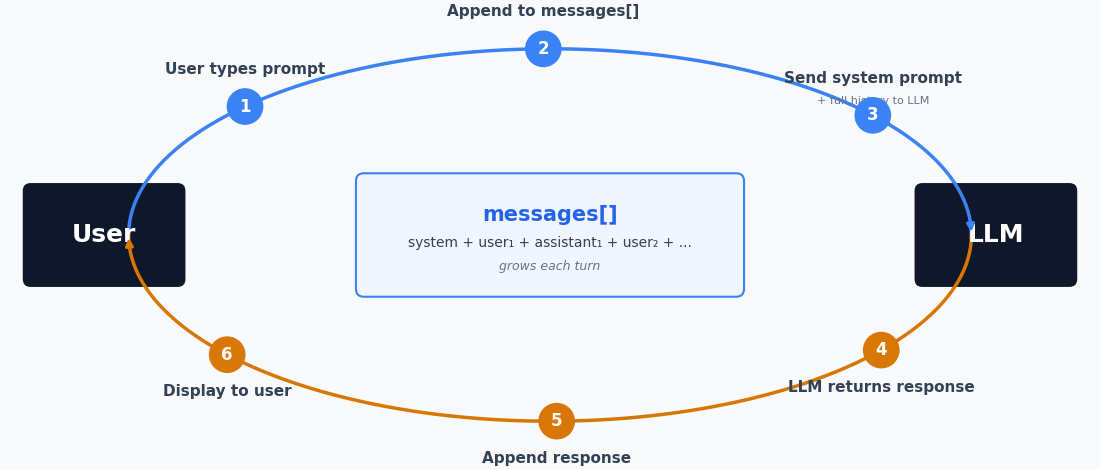
A chatbot produces text
What it receives
A system prompt, the conversation so far, and your message.
What it returns
More text.
It cannot open your file, run your query, or check its own arithmetic.
Inside a chatbot
An agent has three parts
The model
Decides. Emits text: sometimes an answer, sometimes a request to use a tool.
The harness
Ordinary software wrapped around the model. Runs the tool the model asked for.
The tools
The things that touch files, databases, and other systems.
The model never runs anything itself. It chooses tools to use. The harness executes, and the harness returns information about the tool outcome to the model.
What the tools are
Read and write files
Documents, spreadsheets, code.
Run code
Python, SQL, the command line.
Search and fetch the web
Run a search, then download and read a page.
Use a screen
Click and type in a browser or a desktop app.
Call a service
A database, an API, or Gmail and Slack through a connector.
Start another agent
A subagent with its own instructions and tools.
Smaller ones are common too: ask you a question, save a memory, load a skill, keep a to-do list.
Inside an agent
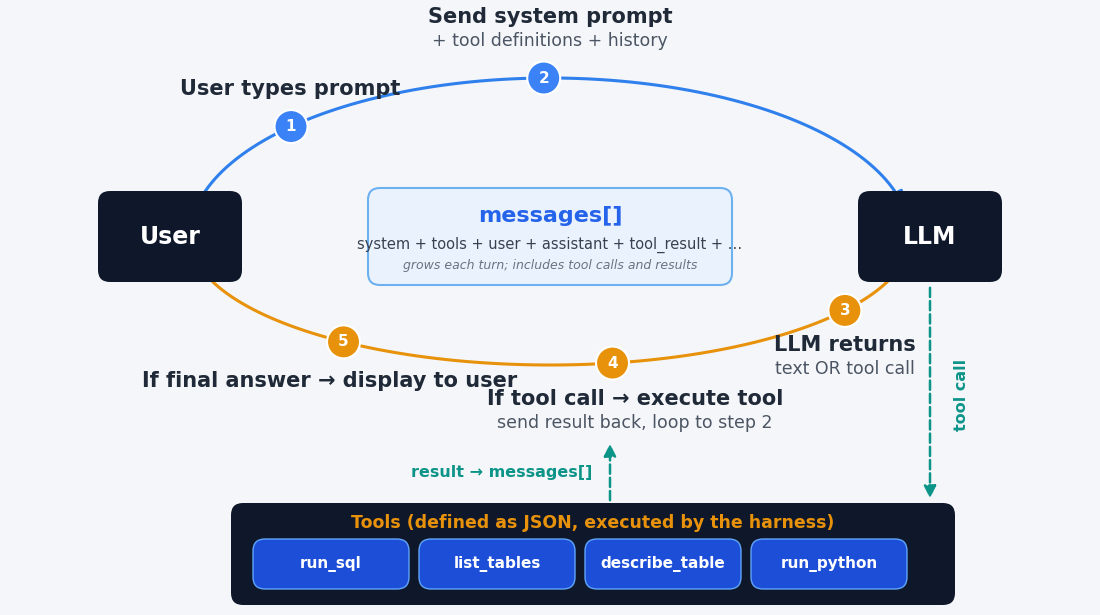
Prompt and response
Prompt: harness to model
The loop
- You ask. One sentence, in ordinary language.
- It picks a tool. The model emits a tool name and arguments instead of an answer.
- The harness runs it. Software outside the model checks the call against its rules, then runs it.
- The result goes back. The harness appends what it keeps; the model reads it and decides what is next.
Repeated until the model answers instead of asking, or until the harness hits its turn limit.
What the model is sent
The system prompt
Your message
Every prior turn
A description of each tool it may call
The contents of files you attached
The result of every tool call so far
All of it is text, and the model treats all of it the same way.
Five choices written into the harness
What the model reads before it writes
What is dropped when the model’s context fills
Which of the model’s tool calls run without asking you
What happens when a tool call fails
Whether to generate subagents
The programmers who wrote the harness made these choices in code, before you typed anything.
Harnesses by name
| Harness | Where you meet it | |
|---|---|---|
| Anthropic | Claude Code | Terminal, desktop app, IDEs, web. The Claude Agent SDK for agents you build. |
| OpenAI | Codex | Codex CLI, ChatGPT desktop app, IDEs, cloud. The Agents API (beta, Sep 10) for agents you build. |
| Antigravity | Desktop app and Antigravity CLI. Replaced Gemini CLI in June 2026. | |
| Open source | OpenCode · Pi · OpenHands · Goose | Any provider’s models, including open-weight models you host. |
Codex CLI is also open source (Apache 2.0) but is built around OpenAI’s models.
Try it
- Install OpenCode 1.18.0 or newer: opencode.ai/docs.
- Put orders.csv and order_details.csv in a new folder. Then type
opencodein a terminal opened in that folder:
Mac: open Terminal, typecd, drag the folder onto the window, and press Return.
Windows: right-click the folder name in File Explorer and choose Open in Terminal. - Type
/modelsand choose Big Pickle under OpenCode Zen. It is free and needs no account. - Ask: Merge orders.csv and order_details.csv on OrderID and save the result as orders_complete.csv.
- Ask: List the exact names of every tool you have.
Free models may train on your prompts. Use nothing confidential.
5 · Doing work with AI
Where to work
Online chatbot
In a browser. Nothing to install.
Desktop app or CLI
Installed on your computer. Works with files on your computer.
lab803.kerryback.com
A container on a server, with the software already installed.
lab803
Sign in at lab803.kerryback.com with your NetID as the username and your Rice student ID (S followed by eight digits) as the password.
A container
Each of you has a container on a Linux server.
Claude Code and Python
Both are installed in each container.
Sonnet 5
Claude Code is connected to Sonnet 5 through an API key.
Workspace
Right panel
Claude Code. The prompt window is at the bottom.
Left panel
Files (the default), Terminal, and View. Ignore Terminal and View for now.
Three-dots menu in Files
Upload from your laptop and download to your laptop.
Important
Refresh
Click Refresh, above the left panel, to see a new file in Files.
No Microsoft Office
Double-clicking a Word, PowerPoint, or Excel file will not open it. Office is not installed.
Download
Download Office files from the three-dots menu and open them on your laptop.
Explore
Ask
Ask a question, anything. Type in the prompt window and press Enter.
Upload
Upload a Word doc and ask Claude to read it.
Download
Ask Claude to create a Word doc, then download it and read it.
Working with Claude Code CLI
Stopping and starting
To exit Claude Code, press Ctrl-C twice.
- In lab803, press Enter to reconnect. A new conversation starts.
- In other environments, type
claudeand press Enter for a new conversation.
Slash commands
Prompts that start with /.
/clear |
Clear the context window |
/resume |
Resume a previous conversation |
/help |
Get help on using Claude Code |
Managing conversations
Start a new conversation for a new task
AI reads the entire conversation again each time you prompt. Irrelevant stuff consumes tokens and may be confusing.
When a conversation gets very long
Tell AI to write a handoff document so you can start a fresh conversation.
Try it: build an Excel workbook
Tell Claude: Build an Excel workbook containing a mortgage amortization table. Include a chart of the amount going to interest and the amount going to principal each month.
Download and investigate
Download the file, open it on your own machine.
- Click a payment cell. Formula, or a number?
- Change the rate to 12%. Does the chart move?
- Change the term to 15 years. Does the table shorten?
If any answer is no, say so in one sentence and ask Claude to fix that specifically.
Ask for something else
- Ask Claude to add a worksheet containing a plot of the monthly payment as a function of the interest rate.
- Download and check.
Try it: data wrangling, charts, docs
In the Claude tab at lab803, the five Northwind spreadsheets are in data/. Elsewhere, download northwind.zip.
- Ask: Which countries generated the most revenue?
- Ask: Create a bar chart of revenue by country for the top five countries.
- Ask: Create an Excel workbook containing the revenue table and the chart.
- Ask: Create a Word document containing a one-page summary with the table and the chart.
- Ask: Create a PowerPoint deck containing three slides: the question, the table, and the chart.
Open each file before asking for the next. At lab803, download it from the file browser tab.
The xlsx, docx, and pptx skills
An Office file is a zip archive of XML files. Skills tell the AI which tools to use to write it.
| Skill | New file | Existing file |
|---|---|---|
| xlsx | Python (openpyxl, pandas) | Python (openpyxl) opens the workbook and changes cells and formulas |
| docx | JavaScript (docx-js) | Unzip, edit the XML with Python, zip again |
| pptx | JavaScript (PptxGenJS) | Unzip, edit the XML, zip again |
The lab has no Office software, so it cannot display the files it makes. Download them and open them on your laptop.
Claude and ChatGPT in Excel
Claude for Excel
From Anthropic. Paid Claude plans: Pro, Max, Team, Enterprise.
Cites the cells behind its answers. Edits cells without breaking formulas. Builds pivot tables, sorts, and filters.
Also available for PowerPoint, Word, and Outlook.
ChatGPT for Excel
From OpenAI. All ChatGPT plans. Also works in Google Sheets.
Builds sheets from a description, writes formulas, and sorts and updates tables.
Asks before it edits the workbook.
Both work inside Excel on the open workbook. The xlsx skill never opens Excel; it runs Python to write the file. Anthropic warns that an outside workbook can hide instructions the add-in will follow.
6 · Prompting tips
Plan
Prompt
Plan this and explain your plan to me.
Afterwards
Prompt
Explain what you did step by step. Did you make any decisions that we have not discussed? Write this as an HTML doc.
HTML is easy for AI to write and easy to read.
Numbers need code
If a number appears in prose and no code produced it, it was predicted.
Prompt
Compute this in Python and show me the code and the output. Do not report a number you did not compute.
The same rule applies to counts, percentages, dates, and anything summed across rows.
Verify claims
Ask what would falsify it
“What would have to be true for this to be wrong, and how would I check?”
Make it show its source
The file, the row count, the line of code.
Generator–critic
- Get the first answer.
- Start a fresh conversation and give it the answer without the reasoning that produced it.
- Ask it to find what is wrong with it.
- Take the objections back to the first conversation.
The second conversation has no stake in the first answer.
Good enough prompting
Most ‘prompt engineering’ techniques from a few years ago are now either useless or actually counterproductive.
Tell it what you want, not what to do
I want … How can we do it?
If something doesn’t work
Try again.
Treat AI as an infinitely patient colleague with a poor memory.
Try it: planning
Three rigs, twenty wells, minimize lost production: workover.md. At lab803 it is in data/.
- Upload workover.md and ask: Find the best routes for the rigs.
- Start a new conversation (
/clearin the Claude tab). Upload the file again and ask: Plan how to do this and share your plan. Read the plan, then ask it to proceed.
Did it use the same method both times?
Try it: explain and critique
- Ask: Write an HTML doc explaining what you did, step by step.
- Start a new conversation. Tell it to read the HTML doc and ask: Read this and critique the method.
MGMT 803 · Rice Business