MGMT 803, MBA@Rice, 2026
Documents and local models
J. Howard Creekmore Professor of Finance
This session
- Retrieval augmented generation
- Gemini Notebook
- Running models locally
21 · Retrieval augmented generation
Structured and unstructured
Structured data
Rows, columns, joins.
Everything else a firm holds
Contracts, mail, board papers, policies, reports, decks, notes.
65% of data leaders call their structured data ready for AI. 39% say the same of the unstructured kind, which is most of the volume.
Why not just paste it in
It was not trained on yours
Your contracts were not on the public web. Nothing in the weights knows them.
The window is finite
A million tokens is large and your document store is larger.
You pay for every turn
Input is billed each turn. Pasting the corpus into every question bills the corpus every question.
Four steps
- Chunk. Split the documents into passages of a few hundred words.
- Embed. Turn each passage into a vector, the same way tokens became vectors.
- Retrieve. Embed the question and find the handful of passages closest to it.
- Paste. Put those passages in the prompt, with the question.
The model never reads your corpus. It reads an excerpt that a similarity search chooses.
A passage becomes a vector
An embedding model reads a passage and returns a fixed-length list of numbers — 384, or 768, or 1,536, depending on the model.
Passages about the same thing land near each other, whatever words they used. “Revenue fell in the third quarter” sits close to “Q3 sales were down”, and a keyword search for “revenue” finds only the first.
The similarity is the cosine between the question’s vector and the passage’s. No model is involved until the passages have already been chosen.
Cosine, in two dimensions
Demo
Five documents for a fictional company: a returns policy, an August board memo, an employee handbook, a shipping service-level page, and September operations meeting notes.
all-MiniLM-L6-v2 embeds and Qwen3-1.7B answers, on the laptop.
22 · Gemini Notebook
Formerly NotebookLM
NotebookLM became Gemini Notebook in July, 2026. Same product, same notebooks, new address: notebook.google.com.
You give it sources. It answers from those sources and cites the passage it used. Nothing you upload is added to a public index.
What goes in, and how much
Sources
PDFs and files you upload, Google Docs and Slides, web pages, YouTube links, pasted text.
Caps
500,000 words or 200MB per source. No page limit.
| Free | Plus | |
|---|---|---|
| Notebooks | 100 | 200 |
| Sources per notebook | 50 | 100 |
| Chats per day | 50 | 200 |
Citations in the answer
- Ask a question. The answer arrives with a numbered marker after each claim.
- Click the marker. The source opens at the passage the claim came from.
- Ask something the sources do not cover, and it says they do not cover it.
Outputs
In addition to chat, Gemini Notebook offers video (slide deck) overviews, audio overviews (podcast style), flash cards, and more.
Breakout exercise
- Create a Gemini notebook from the slide decks for this course, and ask it questions.
- Upload the decks to lab803. Tell Claude you want a RAG chatbot built on them.
- Have Claude lay out the options for chunking, for the embedding model, and for the model that writes the answer. Decide each one with it.
- Build it as a FastAPI app.
23 · Running models locally
Where each tier stands today
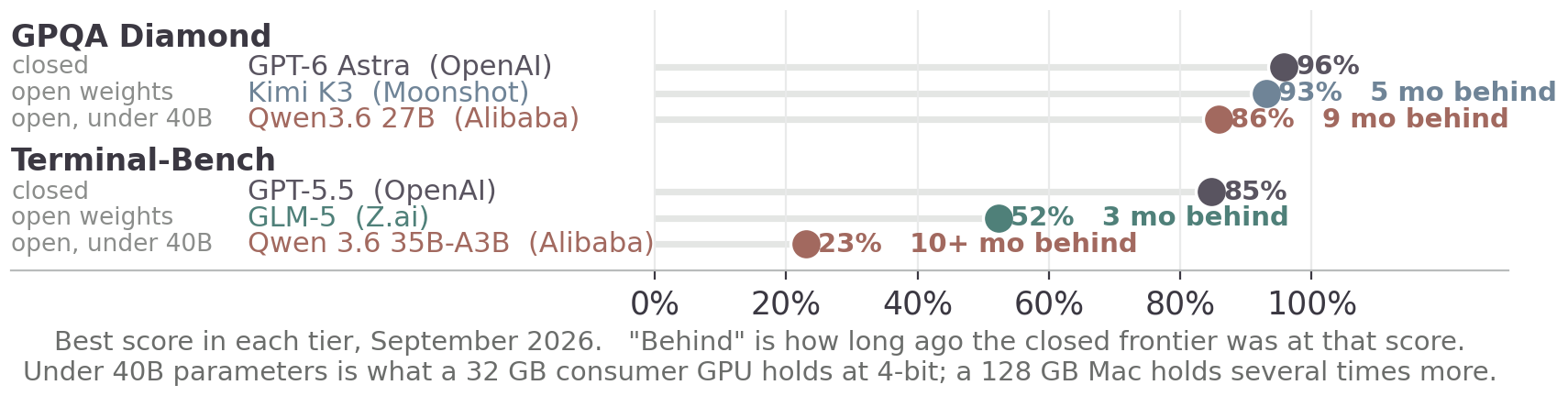
GPQA Diamond is near its ceiling, which compresses the gap: five months of lag is worth three points because there is nowhere left to go. Terminal-Bench is not near any ceiling, and there the same few months is most of the task.
Not every job needs the largest model
| Where it runs | What it suits | |
|---|---|---|
| A frontier model | the provider’s API | judgment, long context, code |
| A mid-size model | the same API, less per token | classification, extraction, routing |
| A small open model | your own hardware | high volume, or data that cannot leave |
| A fine-tuned small model | your own hardware | one narrow task, done constantly |
The price difference is negligible on a single question and decides the budget at a million classifications.
Fine tuning by distillation
Run the frontier model on a few thousand examples of your task. Keep the inputs and its outputs. Train a small model on those pairs.
The small model does not become generally capable. It becomes capable at the one task you sampled, at a fraction of the cost per call, on hardware you control.
It is generally OK to do this, but perhaps not if you plan to compete with the frontier model. China’s distillation
What fits on hardware you own
| Memory | What runs at 4-bit | On disk | |
|---|---|---|---|
| A laptop, no GPU | 8 GB | 1B to 4B | Gemma 3 4B, 3.3 GB |
| A laptop with a GPU | 16 GB | up to 12B | Gemma 3 12B, 8.1 GB |
| One consumer GPU | 24 GB | up to 32B | Qwen 3.8 27B, 17 GB |
| DGX Spark | 128 GB unified | 70B class | |
| Mac Studio | 256 GB unified | 235B class |
A model needs roughly half a gigabyte per billion parameters at 4-bit, plus room for the context window.
Capacity decides whether it loads. Bandwidth decides how fast it answers: the Spark moves 273 GB/s, the Mac Studio 819 GB/s.
Breakout exercise part 1
- Install Ollama: ollama.com/download.
- In a terminal, type
ollama run gemma4:e2b-it-qat. The download is 4.3 GB. - Ask it something you asked a frontier model. Compare the two answers.
- Type
/byeto leave. Then runollama run gemma3:1b, an 815 MB download from the previous generation, and ask the same question again.
Nothing you type leaves your machine. In a second terminal window, ollama ps shows what is loaded and how much memory it holds.
Breakout exercise part 2
Part 1 creates a local chatbot. For a local agent, we need a harness.
- Install OpenCode 1.18.0 or newer: opencode.ai/docs.
- Put orders.csv and order_details.csv in a new folder, with the
opencode.jsonon the next slide. - Run
opencodein that folder, type/models, and choose Gemma 4 under Ollama. - Ask: Merge orders.csv and order_details.csv on OrderID and save the result as orders_complete.csv.
- Ask: List the exact names of every tool you have.
- Write down where it stopped being able to do the job.
Same model as the exercise before, so nothing more to download. Gemma 4 supports function calling, and Python is already installed, so it has tools and something to run them with.
MGMT 803 · Rice Business